
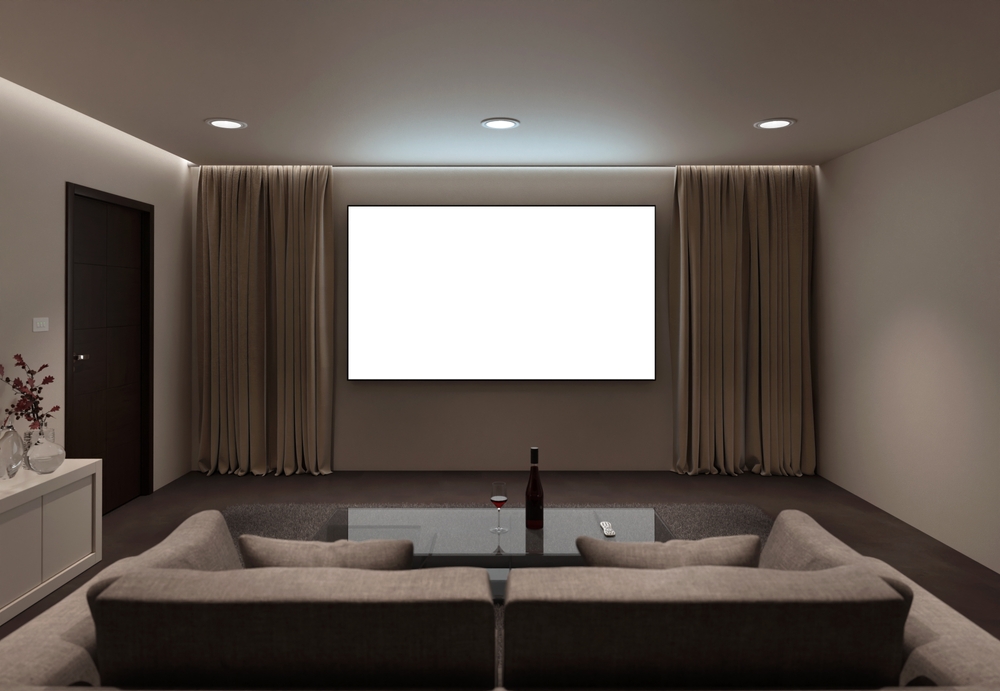
A luxury home theater system almost never disappoints because someone picked the wrong receiver. It disappoints because the room was never measured, the sofa sits two feet off the back wall, and the overhead cans stay at full brightness during the opening credits. The gear is the easy part; the room, the layout, and the control layer are what separate a big TV with speakers from something that makes guests stop talking.
Below is how Elite Smart Home actually approaches the problem, in the order the decisions matter.
The Room Sets The Ceiling On Everything Else
Acoustics are physics, and physics does not care how much the speakers cost. A rectangular room with parallel bare walls, tile or hardwood floors, and a low ceiling will smear dialogue and pile up bass in the corners no matter what you install.
Three treatments fix most of it before you spend a dollar on electronics:
- First reflection points: absorptive panels on the side walls at ear height, roughly halfway between the front speakers and the primary seat.
- Bass control: corner traps or a second subwoofer placed asymmetrically, which evens out the 40 to 120 Hz range far more effectively than a single larger sub.
- Soft surfaces: heavy drapery, a thick rug with pad, and upholstered seating to pull reverb time down toward the 0.3 to 0.4 second range most designers aim for in a dedicated room.
If the space is a shared living room, you are negotiating rather than designing, and that is fine. Just recognize that a multipurpose room with glass on two walls has a performance ceiling, and high-end electronics will not raise it.
Screen Size And Seating Distance Are A Math Problem
SMPTE recommends a 30-degree horizontal viewing angle from the main seat, while THX pushes closer to 36 degrees for a more cinematic feel. In practical terms, a seat 10 feet from the screen wants roughly a 100 to 120-inch projection image, or a 77 to 98-inch flat panel.
Most people buy a display one or two sizes too small, then sit too far back to notice the resolution they paid for. A quick rule: multiply your seating distance in inches by 0.6 for a reasonable diagonal, so 120 inches of distance suggests about a 72-inch minimum.
Projection still wins above about 110 inches on cost per inch, but it demands light control. If you cannot get the room to near-black, a high-brightness laser projector with an ambient light rejecting screen, or simply a large OLED or mini-LED panel, will look better nine nights out of ten.
Speaker Layouts: Where 5.1 Stops And Atmos Begins
A 5.1 surround sound setup remains the baseline: left, center, right, two surrounds, and a subwoofer. It handles the vast majority of streaming content well and keeps the install simple in a shared room.
Where object-based audio changes things is overhead. Dolby Atmos adds height channels, and the jump from 5.1 to 5.1.4 (four in-ceiling speakers) is usually a bigger perceived upgrade than moving from decent speakers to expensive ones. Common configurations in luxury builds:
- 5.1.2: good for living rooms with one row of seating and limited ceiling access.
- 7.2.4: the sweet spot for dedicated rooms up to about 20 feet long, with two subs for smoother bass across seats.
- 9.2.6 and beyond: worth it only in purpose-built rooms with two rows of risers and a processor that supports the channel count.
Installing high-end home theater systems in NJ requires careful attention to brand pairing and room acoustics. Brand matters less than matching timbre across the front three speakers; mixing a bright center channel with warm towers creates a dialogue problem that no calibration fully solves.
When Wireless Home Theater Systems Actually Make Sense
Wireless rear speakers have improved enormously, and for a retrofit in a finished room with plaster walls, they are often the honest answer. Latency on current platforms sits low enough that lip-sync issues are rare, and the convenience of not fishing cable through a 1920s wall is real.
The tradeoffs are worth knowing: every wireless speaker still needs mains power nearby, battery-free designs are the only ones worth installing permanently, and most wireless ecosystems lock you into one brand for future expansion. In new construction or a gut renovation, pull the wire. Conduit to the ceiling and back wall costs a few hundred dollars during framing and saves a major headache later.
The Automation Layer Most Buyers Skip
This is the gap between a good theater and a luxury one. A single button labeled “Movie” should drop the shades, dim the sconces to 15 percent over three seconds, switch the display input, set the receiver to the right listening mode, and nudge the thermostat down two degrees because eight bodies in a sealed room generate heat.
Designing a true custom home theater in Philadelphia means integrating smart scenes that transform how the space feels. Worth building into the control scene:
- Tunable lighting with warm-dim behavior, so lights shift toward 2200K as they dim instead of going dull gray.
- Pathway lighting at 5 percent on the step risers and aisle, tied to the “Pause” command so no one trips on a refill run.
- Automated shades or blackout drapes on a timed sequence rather than a single abrupt close.
- Rack ventilation and remote reboot for the AV equipment, which prevents the 9 p.m. call about a frozen streaming box.
Members of CEDIA, the trade association for home technology integrators, generally program these scenes during commissioning, and it is the step that makes a complicated system feel like a single appliance.
System Integration and Structural Design
When designing a dedicated media room, a significant portion of the effort and investment focuses on structural elements and spatial integration rather than just the components themselves. Room isolation, acoustic framing, specialized drywall damping, custom risers, and dedicated electrical runs form the backbone of any high-performance space.
Working with Elite Smart Home guarantees that structural design, thermal management for equipment racks, and acoustic treatments are planned alongside the audio and video hardware, creating a seamless environment custom to the home.
Calibration Is Not Optional
Running the auto-setup microphone that shipped in the box gets you maybe 70 percent of the way. Professional calibration uses multi-point measurement, sets crossovers by measured roll-off rather than guesswork, aligns subwoofer phase and time, and adjusts the display for accurate color and black level.
Budgeting time for professional tuning yields consistently the highest return on investment. On any high-performance system, calibration is the step that translates raw hardware capability into accurate, immersive sound and picture, and it should be repeated any time you move a speaker, add furniture, or swap a component.
Start Planning Your Home Theater Today
Send over your room dimensions, ceiling height, and a rough budget range, and Elite Smart Home will map out a layout, speaker configuration, and control scheme that fits the space you actually have. Early planning, before drywall or furniture decisions, saves the most money. Contact Elite Smart Home today to get started.